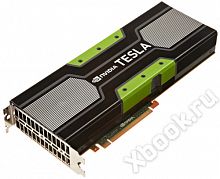
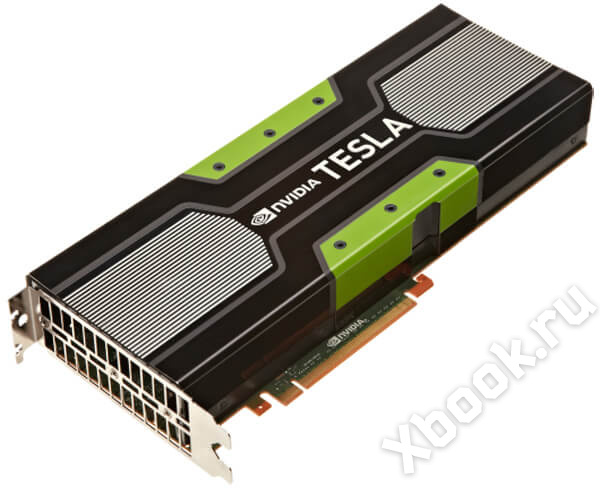
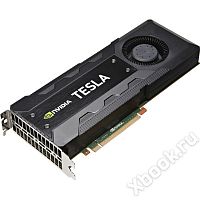
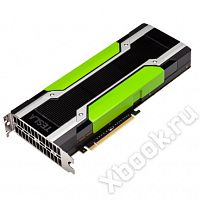
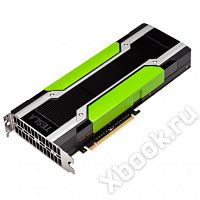
| TESLA K20X - PRODUCT SPECIFICATIONS |
| CUDA Parallel Processing Cores | 2688 |
| Interface | 320-bit |
| Frame Buffer Memory | 6 GB GDDR5 |
| Memory Bandwidth | 250 GBytes/sec |
| Displau Connectors | None |
| Max. Power Consumption | 225 W |
| Power Connectors | (2) x 6-pin PCI Express power connectors |
| Graphics Bus | PCI Express 2.0 x16 |
| Form Factor | 110 mm (H) x 265 mm (L) - Dual Slot |
| Thermal Solution | Passive |
| Peak double precision floating point performance (board) | 1.31 teraflops |
| Peak single precision floating pointperformance (board) | 3.95 teraflops |
| Number of GPUs | 1 x GK110 |
| GPU computing applications | CFD, CAE, financial computing, computational chemistry and physics, data analytics, satellite imaging, weather modeling |
| Architecture features | SMX, Dynamic Parallelism, Hyper-Q |
| System | Servers only |
| ECC Memory Error Protection | Meets a critical requirement for computing accuracy and reliability in datacenters and supercomputing centers.
External and internal memories are ECC protected in Tesla K20X. |
| System Monitoring Features | Integrates the GPU subsystem with the host system’s monitoring and management capabilities such as IPMI or OEM-proprietary tools. IT staff can thus manage the GPU processors in the computing system using widely used cluster/grid management solutions. |
| L1 and L2 caches | Accelerates algorithms such as physics solvers, ray-tracing, and sparse matrix multiplication where data addresses are not known beforehand |
| Asynchronous Transfer with dual DMA engines | Turbocharges system performance by transferring data over the PCIe bus while the computing cores are crunching other data. |
Flexible programming environment with
broad support of programming languages and APIs | Choose OpenACC, CUDA toolkits for C, C++, or Fortran to express application parallelism and take advantage of the innovative Kepler architecture. |



 Информация об оплате
 Под заказ


 В корзину